Showing posts with label invasive. Show all posts

Monday, May 23, 2011

Frass

Working in the backyard Saturday (the first nice day in over a week) I kept hearing a strange sound.  It sounded kind of like it was starting to rain.  But it was warm and sunny.  What was that noise?

Here's a clue.  Look at those maple leaves.


Here's another clue.  This is a Viburnum that is under the maple trees.


Got an idea yet?


Here is the culprit.  The caterpillar of the Winter Moth (Operophtera brumata).


This is an introduced species that has become a major pest here in Eastern Massachusetts.  They can completely defoliate trees of preferred species (a neighbor has a weeping cherry that is in decline from years of winter moth damage.  She has to resort to spraying to keep this full sized specimen alive).  While a healthy tree can survive defoliation once several years of defoliating can cause the death of the tree.

Oh, that sound?  That's the sound of millions of caterpillars chewing on leaves.  And the dark spots on the Viburnum leaves are the Frass (feces) of all of those caterpillars

No, I'm not kidding, you really can hear them.

Monday, May 10, 2010

Miscellaneous Monday

It's another Monday on the Edge.  It's almost the end of the semester so I'm really busy with my teaching duties.  The final will be next Monday and then - BREAK!  Woo-hoo.  Bet you didn't know teachers looked forward to the end of the semester nearly as much as the students do, did you?

Between the end of the semester busys and the high winds we've been having for the past week I haven't been keeping up with this blog so here's a few tidbits to tide you over until the semester ends and the winds die down so I can get back outside with my camera.

The most disturbing sound ever.  Sorry, I didn't record it but this little thing is the cause of a lot of trouble up here.


It's the caterpillar of the winter moth (Operophtera brumata).  It's a European species that has become a major invasive pest here in New England.  The numbers of these brats are astonishing.  They can defoliate a good sized tree in less than a week (my neighbors beautiful 20 year old weeping cherry.  She noticed the caterpillars on Friday, called a company to come spray the tree and by the time they arrived on Monday it was too late - the tree had no leaves left.  They don't go after most trees this bad but they do a lot of damage).  I found this one on the sidewalk.  Did I mention it's been windy?


I've seen birds with beaks full of these guys, carrying them back to feed nestlings but I guess the caterpillars beat most birds.  We're only now getting Warblers (most of whom eat insects) coming through and it's still early in the nesting season so not too many baby birds to be fed.

The sound?  Oh, yeah.  There are so many of these guys that when I walked back into the woods last week I could HEAR them chewing.  Very disturbing.

Three dollar orchid.  This is the bloom from an orchid I bought at a big box store for $3.  It had quit blooming and was on sale.  The flash washes the color out of bit but if you look at the flower to the left you can see a bit of greenish color.  That's the color of the petals.  Very cool looking.


I noticed that both this Phalenopsis and another one I have blooming seem to have little sparkles on the petals.  I'm not sure what causes this but it's pretty cool looking.  I guess this is the effect they're trying to replicate when they spray glitter onto the bracts of Poinsettias at Christmas.

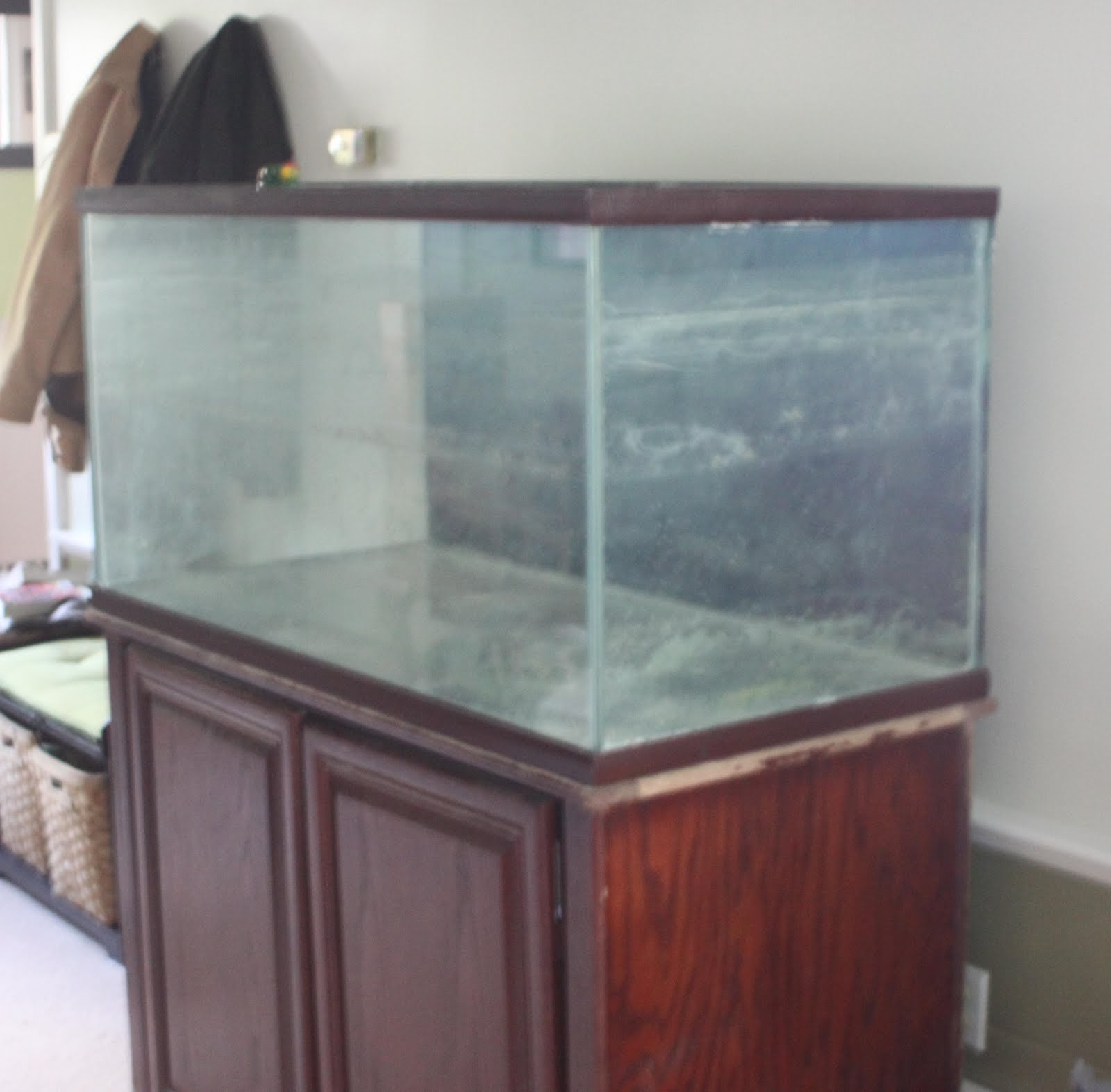
Not a plant thing but....  The Husband has a cousin who left this 120 gallon fish tank at his parents' house for years and years.  Finally (ok, so it only took asking) we convinced him to let me have it and voila!  Yes, it's dirty and yes the stand is showing some wear and tear but after some work it's a free (well, it cost us about $100 to rent a truck to move the tank -it's four feet by two feet by two feet - and the stand) large tank.  I will put plants in it.  Probably not till next winter, after outdoor gardening season is over for the year.  This will make a nice indoor water garden.


And now for some pretty pictures.  Just because.

Tulip is Tinka (from Brent and Becky) and the shrub is a Blue Mist Fothergilla gardenii


Cute little rabbit under the Epimediums. Excuse the soaker hose.

Remember the conjoined tulip buds?  They formed two normal sized and normal shaped blooms that share a stem.  This is Hollandia and is from Messelaar's

This tulip was advertised as a 55-mph tulip.  I prefer the close up where you can see all the different colors.  This is called El Nino and is from Brent and Becky's Bulbs

This is just a nice red tulip.  I think it's called Cum Laude (unless the purple one is Cum Laude in which case this one is Hollandia.  I didn't label them.  Bad Gardener, no compost!) and it came from Messelaar's (which is just up the road from me.  So much fun to wander in and select my own bulbs.  So easy to go overboard doing it).

I like the detail inside tulip blooms.  Too bad I haven't been able to get inside the purple blooms (did I mention the winds up here, it's very hard to photograph long stemmed flowers in the wind).  The inside of those has blues and greens.  Very neat.

Wish me luck on the final exam.  Writing and grading it, I mean.  I give it next Monday.

Saturday, December 19, 2009

Winter Moths

When I first saw the mass of moths attracted to the lights beside the garage I thought it was an interesting phenomenon.


Then I heard someone say they were winter moths.  That made me think they would make a good blog subject.  I had read something about winter moths in Bernd Heinrich's Winter World.  So I started doing some research.  An insect that flies during the winter, they must have some really cool adaptations.


Then I found out that these winter moths are Operophtera brumata, an invasive species.    That's not so cool.

Winter moths are a European species introduced to this continent last century.  They started showing up in New England early this century and are already becoming a major problem.  Winter moth males fly during November to as late as January, the females are wingless and wait on trees and shrubs for the males to find them.  They lay their eggs under the bark.

In the spring the eggs hatch and the larvae begin feeding on the unopened buds.  As the untouched buds start to open the larvae will move to nearby branches or leaves and continue munching.  They can easily defoliate whole trees, with a preference for fruit trees.  In springs like our last spring with cool weather and delayed bud opening the damage can be intense. 

Not surprisingly the defoliation process is harmful to trees, it can even be fatal if repeated over several years.  On the plus side the spring migrating birds (especially warblers) have plenty to eat at a critical time in their life cycle.  They subsequently arrive relatively plump and ready to go on their nesting grounds.

Our street tree, an American Linden (or Basswood), was heavily infested this past year.  With this massive fall flight I predict it will be heavily infested again this year.  I'm not going to do anything to fight the moths (winter moths are hard to control and professionals should be consulted.  I was unable to find information on an organic option that actually works) at least in part because I think that is the wrong tree for that spot and that spot is really, really bad (directly in front of our front door so people who park on the street have to go around the tree to get to our front walk).  If the tree doesn't survive I'll quietly replace it with something a little more appropriate to the spot and off center from our front door.  Probably not a fruit tree, though.


Saturday, August 1, 2009

Invasive - scary word or overused word

On my train ride into Boston this week and instead of reading my book I was looking out the window at the plants and animals along the tracks. The tracks I ride go through some nice wetland areas and I can see Great Blue Herons, Great Egrets and at one point there is usually a pair of Mute Swans visible. This week I could see they have a cygnet (young swan) with them. That got me thinking about exotic species and invasive species and aggressive species and the misunderstandings and confusion caused by those terms.

Mute Swans occur in the wild in Northern Europe. In the US they have escaped from captivity or been released into the wild and have started establishing themselves. Up here in New England they are not a major problem but down in the Chesapeake Bay area they have become quite a problem, altering the local habitat and negatively affecting other species.

Plants can be problematic, too. Species such as multiflora rose, English ivy, Chinese Wisteria, Crepe Myrtle, Japanese honeysuckle and Bradford Pear have all escaped captive culture into the wild. In the wild they may or may not out compete native plants.

English Ivy, Wisteria, and honeysuckle will form dense mats of one species. These mats can strangle large trees and smaller native plants. They reduce the biodiversity of the areas they invade. Most of the time they don't benefit local wildlife and by smothering native plants they actually reduce the local food sources (although English Ivy will increase local rat populations since it hides them from predators). These monster plants are termed Invasive Exotics. Invasive is sometimes used by itself with the term Exotic understood. Exotic simply means they are not native.

Plants that are native but spread and take over (especially in the garden) are termed aggressive. Many gardeners will use the stronger term invasive to describe these plants but that is kind of like referring to every cold as the flu. The flu is a specific infection, not all head colds are the flu.

Even the term native is not always clear. What time period are you referring to? Pre-Columbus? I'm sorry but no one got off of the first ships here and did an intensive inventory of the native plants and animals so we really don't know what was here before Europeans. And if you want to go back before Native Americans well, that was a very different America. In fact I don't mean to shock you but we still don't have a complete survey of life forms in America. Check out www.dlia.org/ for information on the Smokey Mountain Biodiversity Inventory Initiative that is attempting to correct this for a small part of the Great Smokey Mountains. They have found plenty of species previously unknown to science just in the past few years.

OK, so let's set a random date and say all species that occurred before 1800 will be called native. What about the species that showed up here without help from humans since then? Two species of Ibis, the Glossy and the White-faced Ibis, both arrived on the shores of the US without help (probably blown across the Atlantic with stormy trade winds) and have since spread completely across the country. So are they native? Or are they exotic?

Let's recap. Invasive is a term that refers to a plant or animal that escapes (or is released) into the wild, except by some people who use it to refer to species that take over the garden but wouldn't survive in the near-by semi-wild lands. Aggressive is a descriptive word that means a plant that out-competes near-by plants, whether that occurs in the garden or the wild. OK, that's clear. You can have an aggressive invasive species (like Chinese Wisteria) or a non-aggressive invasive species or even an aggressive native species. Whew.

Then there is the native issue. That word sounds good and is generally used to refer to plants and animals that occur in the wild or semi-wild, without human assistance. But some things, like Pigeons and Starlings, do quite well without human assistance and are definitely not native species. Again it's not too clear cut. And that doesn't even begin to address the issue of species that have shown up in the US without human aid or have spread into new parts of America in the recent past (think Coyotes).

So we have descriptive terms that are not clear cut to describe problematic or potentially problematic species. Why does this matter? Because I believe that as Gardeners we have a responsibility to the local wildlife and ecosystem to do no harm. There are not many truly wild spaces left and all kinds of species, butterflies, birds and wildflowers are in decline due to habitat degradation and human expansion.

There is plenty of evidence that wilderness is valuable to the human psyche so even if you don't value it for it's own sake you should value it for yours. Not to mention the damage to our air and our water supply if we neglect our own ecosystem.

One good thing for gardeners to do is to avoid planting plants that have a tendency to escape and aggressively out-compete native plants. These are the plants that are usually categorized as invasive exotic species. There are various, regional lists out there of the worst bad guys. In North Carolina the North Carolina Botanical Garden has some great information about good and bad plant choices for the Southeastern US (http://ncbg.unc.edu/plants-and-gardening/), and they are a great source for native plants. In New England the New England Wildflower Society talks about them at http://www.newfs.org/protect/invasive-plants. Lastly the USDA also keeps track of species that they consider native and invasive. You can enter individual plants into their databases to find out if that species is problematic in your area. You can find this database as http://plants.usda.gov/.

So why, you ask, did I include a photo of the World's Cutest Cat, Katydid? Guess what beloved pet species can be aggressive, even invasive, when accidentally or on-purpose released into the wild? Katydid is quite happy inside, making sure her blankie doesn't get stolen.